Heavy-duty humanoid volume build
Structural process tuning and scenario validation advanced together, from functional prototype to shipped units.
Prototype to volume
From concept to shipped units, with Fenda Technology as the manufacturing base: assembly, burn-in and scenario zones on two shifts.
Capacity is not rented by the hour. OEM runs inside Fenda Technology (SZSE 002681): separated assembly, burn-in and scenario zones, two shifts a day.
Precision manufacturing built across audio, small appliances, wearables and smart home, reused for robots.
Million-square-metre parks around the Pearl River, plus a ~10,000 sqm heavy-duty robot workshop with five zones.
ISO13485 and IATF16949 systems, in-house CNAS lab with 3D X-ray and CMM inspection.
Critical parts measured to ±0.001mm; MES links incoming material, stations and shipment for full traceability.
Endurance, thermal cycling and EMC tests before shipment, released under a lifecycle validation system.
Harmonic reducers and other key components built in parallel with whole machines, so lead time is yours.
Heavy-duty humanoid robots taken to mass production with embodied-AI partners such as Galbot.
Two-shift 24h production; pilot batches and volume orders switch on the same line without requalification.
Housing to firmware, certification to spares: you own product and brand, we make it manufacturable and repeatable.
ID engineering, sheet metal and injection parts, tooling follow-up, prototypes.
Board redesign, drive and power design, SMT assembly and ICT test.
Joint calibration, burn-in, scenario-simulated runs and outgoing QC.
CE, FCC, CCC, ROHS submission and fixes, with export documentation.
Packaging structure, manuals, nameplates, brand visuals, multi-language.
Spare-part kits, repair flow, field support and standby units.
Ten-to-hundred unit pilots that prove process and yield before scaling.
Two-shift scheduling, line balancing and weekly delivery boards.
| Own line | WTTJQR × Fenda | |
|---|---|---|
| Upfront capex | Equipment and space of tens of millions CNY | Allocated per project with no heavy capex |
| Time to volume | 12–24 months | Prototype to pilot in 3–5 months |
| Quality system | Built and certified from scratch | IATF16949 + ISO13485 already in place |
| Supply leverage | Weak as a new entrant | Group-level purchasing and in-house key parts |
| Demand swings | Idle capacity in low season | Two-shift elastic scheduling |
| Engineering team | Hire process and test staff | Process and test teams already in place |
Product positioning, BOM boundary, certification target and cost target.
Manufacturability review, key-part selection and alternates.
Hand-built and functional units with joint calibration and scenario runs.
From ten units: process, test fixtures and yield curve proven.
Two-shift scheduling, weekly delivery, spares and service in parallel.
The hard part of robot mass production is iteration speed: a structure change waits for a prototype shop, a board respin waits for a fab, a missing connector costs a week. Shenzhen compresses all three into one district — edit in the morning, fab in the afternoon, back in the machine tomorrow.
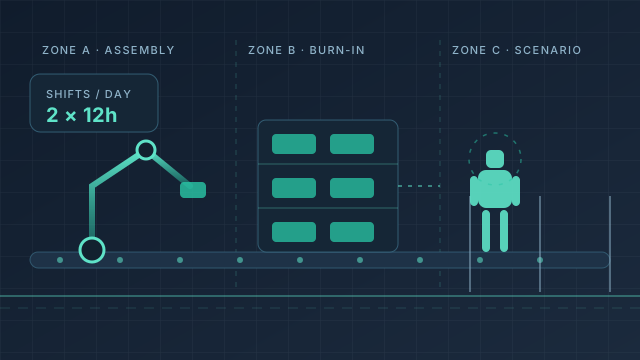
Structural process tuning and scenario validation advanced together, from functional prototype to shipped units.
Prototype to volume
New housing and brand materials, mainboard and firmware reworked to the brand owner spec.
Housing + firmware
Kit structure, harness and packaging as one system, with sorting and burn-in test flows.
Kit delivery
Leg structures and joint assemblies machined in batches with per-part traceable inspection data.
Per-part traceability
Reworked to destination-market certification with export documents, shipped to overseas warehouses.
Certification + export
Body assembly, joint calibration and accuracy re-test for repeatable positioning batch to batch.
Batch consistency
Send the product definition, BOM or prototype photos; we come back with a manufacturability read and schedule.
Leave your process and contact — an engineer replies during working hours. For anything urgent, call us.
No messages yet
Delivered. An engineer will reply during working hours.